


The regulatory framework governing structural materials in New York City has evolved past basic life-safety metrics into a highly sophisticated carbon-accounting system. For commercial architects, LEED consultants, and institutional developers, structural material procurement now dictates project viability.
Under the updated sustainability guidelines enforced by the New York State Homes and Community Renewal (HCR) agency, projects must conform to aggressive embodied carbon thresholds. Meeting these standards demands a deep understanding of material chemistry, advanced supply chain tracking, and a general contractor capable of auditing and verifying complex environmental submittals long before the first delivery arrives on site.
Relevant references:
The Regulatory Landscape of Sustainable Construction Materials
HCR and State Guidelines: The High-GWP Insulation Ban
The baseline parameters for thermal envelope performance have shifted. New York State’s hydrofluorocarbon (HFC) restrictions, adopted by the Department of Environmental Conservation under 6 NYCRR Part 494, prohibit the sale and installation of many foam insulation products that use high-global-warming-potential HFC blowing agents. For most foam plastic insulation applications, these restrictions took effect on January 1, 2025, accelerating the transition toward lower-GWP hydrofluoroolefin (HFO) technologies and other compliant alternatives.
The transition away from high-GWP blowing agents has materially changed how design teams evaluate insulation specifications for multifamily and commercial projects. Specifying low global warming potential GWP insulation in NYC now requires direct verification of the chemical blowing agents used during manufacture, transforming insulating applications from a routine sub-trade installation into a highly scrutinized compliance phase.

Embodied Carbon Disclosures: EPD and LCA Mechanics
Many HCR-funded and sustainability-focused projects now require project teams to collect Environmental Product Declarations (EPDs) for major structural and thermal materials as part of broader embodied-carbon tracking and reporting efforts. An EPD is an independently verified Type III environmental label that acts as a nutritional label for material carbon tracking.
We integrate these documents into a holistic Lifecycle Assessment (LCA) framework, calculating the total cradle-to-gate environmental impacts of the structure. This data is essential for modern project tracking; if a contractor fails to secure product-specific EPDs during the submittal phase, the building owner may encounter funding-compliance challenges, sustainability certification issues, or additional documentation requests during project review.
Sourcing Low-Carbon Materials: Challenges and Solutions
Thermal Insulation Performance: Balancing R-Value with Carbon Footprints
Transitioning to low-GWP insulation requires careful structural planning. Architects must balance the thermal resistance metrics (R-value per inch) against the overall embodied carbon mass of the material to prevent wall assemblies from protruding into high-value interior square footage.
The following comparative table outlines the performance variables of current compliant insulation systems:
| Insulation Type | Typical R-Value per Inch | Embodied Carbon Level | GWP Rating | Primary Sourcing Consideration |
|---|---|---|---|---|
| Cellulose (Loose-Fill) | 3.5–3.8 | Extremely Low | <1 | Requires strict moisture control during installation. |
| Wood Fiber Board | 3.6–4.0 | Carbon Negative | <1 | Excellent acoustic dampening; requires structural depth. |
| Low-GWP Spray Foam (HFO) | 6.0–6.8 | Moderate | <2 | Highly sensitive to ambient and substrate temperatures. |
| Standard Spray Foam (HFC) | 6.0–6.5 | Extremely High | >1000 | Generally non-compliant with current low-GWP procurement requirements. |
Note: While natural fibers like cellulose and wood fiber board offer exceptional carbon-negative profiles, high-performance urban high-rises frequently rely on fourth-generation Hydrofluoroolefin (HFO) blown spray foams to maintain ultra-thin, code-compliant wall assemblies while keeping the GWP rating near zero.
Low-Embodied Carbon Concrete Mix Designs
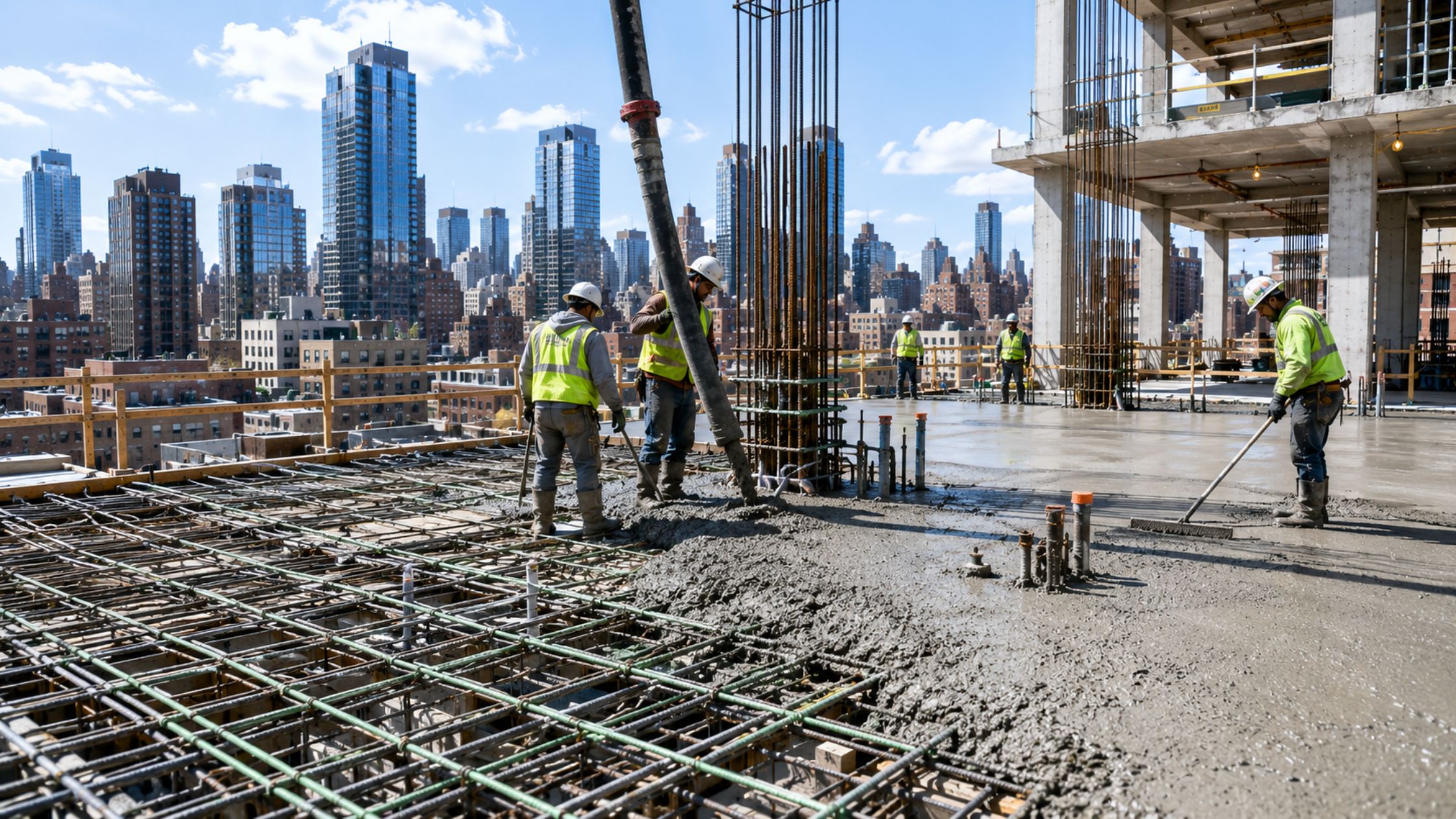
Concrete production remains one of the largest industrial drivers of carbon emissions. To hit HCR’s aggressive carbon-reduction metrics, standard structural concrete mixes must be completely re-engineered.
We achieve this by optimizing structural mix designs using high-percentage Supplementary Cementitious Materials (SCMs). By replacing substantial percentages of traditional Portland cement with industrial by-products like fly ash or ground granulated blast-furnace slag (GGBFS), well-designed SCM mix strategies can significantly reduce embodied carbon compared with conventional Portland-cement-dominant mixes.
Furthermore, we coordinate with regional ready-mix plants to incorporate specialized carbon-curing technologies. These systems inject recycled carbon dioxide directly into the concrete matrix during mixing, permanently mineralizing the gas into calcium carbonate and increasing compressive strength while lowering the overall cement requirement.
Typical Cost Considerations for Low-GWP Material Procurement (2026)
| Material Category | Typical 2026 Cost Consideration |
|---|---|
| Low-GWP HFO Spray Foam | Higher upfront material cost than legacy HFC products; lower regulatory risk. |
| Wood Fiber Insulation | Higher material thickness may affect wall assemblies and usable floor area. |
| Cellulose Insulation | Competitive material pricing; requires moisture-management planning. |
| Low-Carbon Concrete (SCM Mixes) | Cost varies based on SCM availability, mix design, and regional supplier capacity. |
| EPD Documentation & Verification | Additional coordination effort during procurement and submittal review. |
Note: Cost considerations reflect typical market conditions in 2026. Actual pricing varies by manufacturer, project scale, supplier availability, and procurement timing.
The Meraki Sourcing Protocol: Supporting Compliance
Supply Chain Transparency and Pre-Construction EPD Auditing
At Meraki Remodeling, we recognize that an architect’s sustainable design is only as strong as the physical supply chain that supports it. We serve as the technical executor of design intent, translating complex carbon specifications into verifiable field reality.
We reduce submittal risk by launching a rigorous material audit during the early pre-construction phase. Utilizing our unified Common Data Environment (CDE), we interface directly with manufacturers and ready-mix producers to collect, verify, and log facility-specific EPDs before a single yard of concrete is batched or a square foot of insulation is shipped. This disciplined documentation process helps align material selections with both HCR rules and LEED v4.1 evaluation frameworks.
Building with Soul: Championing the Circular Economy
Our operational philosophy combines technical precision with disciplined material stewardship. Beyond meeting baseline compliance requirements, we prioritize responsible sourcing, transparent documentation, and practical strategies that support lower-carbon construction across complex commercial projects.
We support your project’s regional material credits by prioritizing hyper-local sourcing networks, reducing the embodied transport carbon of our material stream. Simultaneously, we implement comprehensive site waste diversion strategies, tracking and routing construction debris—such as clean concrete masonry drop-offs and clean timber cut-offs—back into localized manufacturing lifecycles. We handle the intense data tracking and carbon verification protocols, leaving your design team free to pioneer the next generation of resilient, low-carbon urban architecture.
De-Risk Your Environmental Submittal Pipeline
Navigating the carbon thresholds and material mandates of 2026 HCR guidelines requires an execution partner who treats data tracking and material science as strict engineering specifications.
Are you advancing a high-performance, carbon-capped design and need an expert pre-construction partner to secure compliant materials and lock in EPD validations?
Talk to the Meraki Team About Your Sustainable Sourcing Strategy

Architect & Consultant FAQ: Low-GWP and Embodied Carbon Procurement
Q: What makes insulation low-GWP under NYC and NY State HCR guidelines?
A: Compliant low-GWP insulation completely avoids hydrofluorocarbon (HFC) blowing agents, which often carry a GWP rating greater than 1000. Instead, compliant systems often utilize hydrofluoroolefin (HFO) blowing agents or natural-fiber insulation products with substantially lower global warming potential than legacy HFC-based systems.
Q: How do procurement teams verify Environmental Product Declarations (EPDs) for low-carbon concrete mixes?
A: We collect facility-specific, product-specific Type III EPDs directly from the concrete producer prior to mobilization. These documents must be verified under ISO 14025 standards and outline the exact cradle-to-gate Global Warming Potential metric expressed in kg CO2e per cubic meter for each structural mix design.
Q: Does substituting Portland cement with slag or fly ash affect early-stage structural stripping times?
A: High-percentage supplementary cementitious material (SCM) substitutions—such as replacing 40% to 50% of Portland cement with slag or fly ash—can retard initial setting times. We mitigate this on site by utilizing real-time maturity monitoring sensors embedded within the pour, ensuring accurate structural strength validation before stripping forms.
Q: Can HFO-blown spray foam be applied in sub-freezing winter conditions across the Tri-State area?
A: Yes, but it requires strict substrate preparation. Low-GWP HFO spray foams are highly sensitive to surface temperatures. We utilize indirect industrial heating arrays to pre-condition the structural masonry or concrete substrate to the manufacturer’s recommended installation temperature range, preventing delamination and ensuring the formulation cures to its rated R-value.

